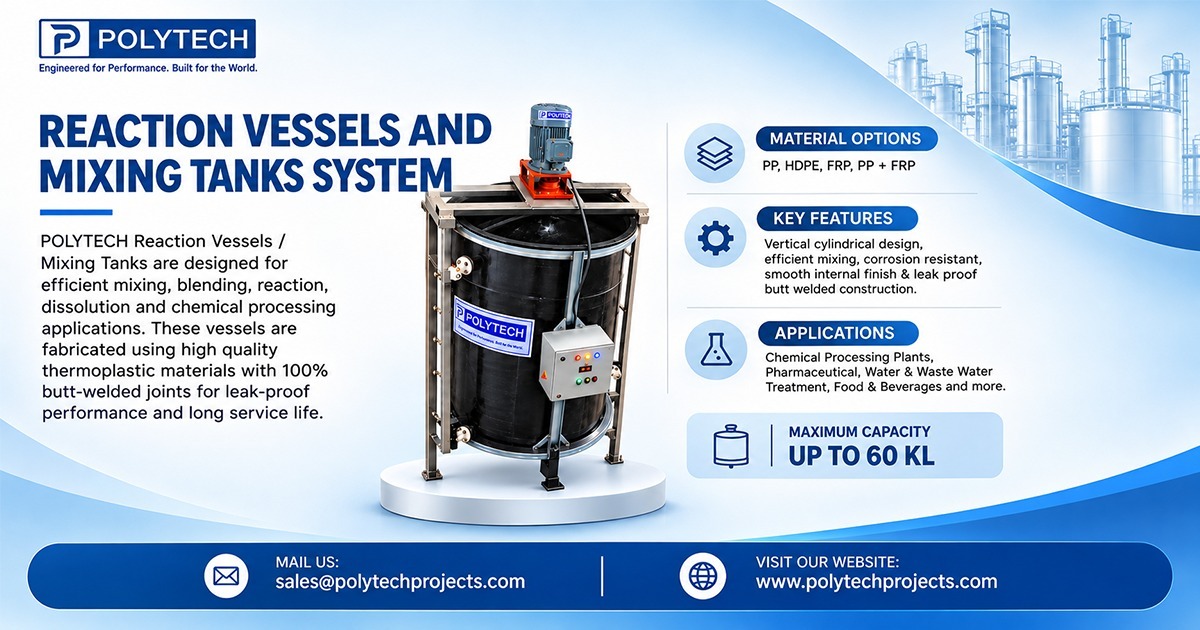
Advanced Reaction Vessels and Mixing Tanks System in Vietnam
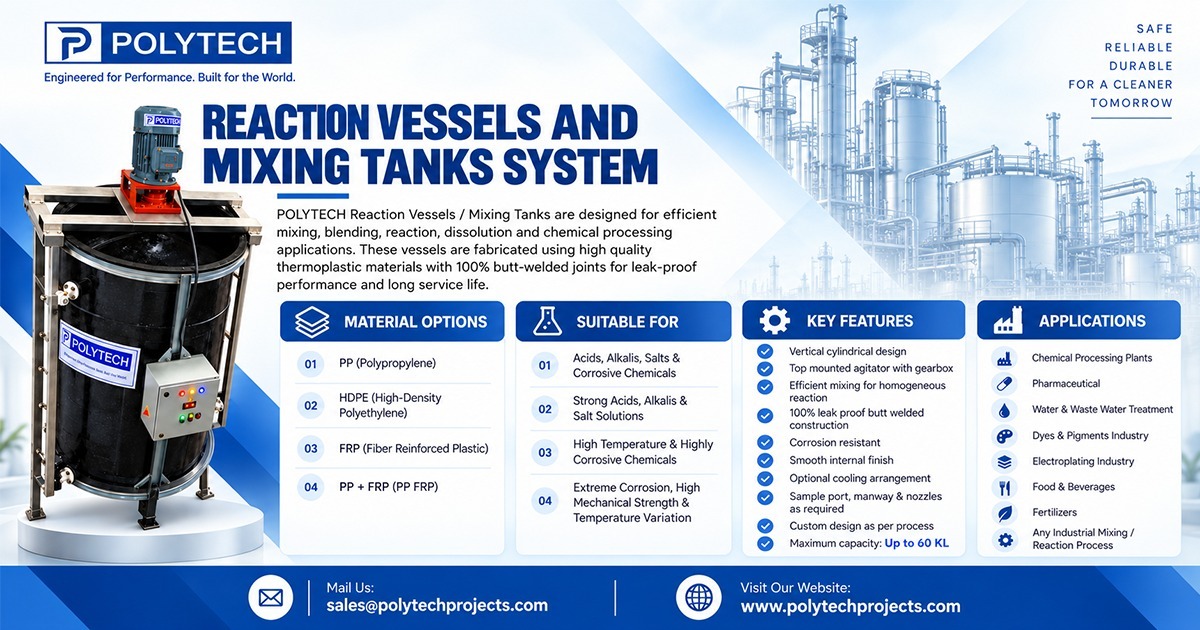
Polytech Projects LLP provides industrial project solutions for businesses requiring process-oriented equipment configurations. We plan our systems around specific manufacturing applications, material characteristics, production capacity, and operational requirements.
Major Process Capabilities Include:
- Controlled blending of liquid and semi-liquid materials.
- Processing of chemical ingredients under defined operating conditions.
- Uniform dispersion of compatible materials through mechanical agitation.
- Heating and cooling arrangements for temperature-sensitive processes.
- Controlled batch preparation for industrial formulations.
- Integration with pumps, pipelines, instruments, and other process equipment.
Understanding the Working Principle of Reaction Vessels and Mixing Tanks
Reaction vessels and mixing tanks operate through coordinated material handling and mechanical processing to achieve the desired product characteristics.
Typical Working Process
- Raw Material Charging: Operators introduce the required ingredients into the vessel according to the production formulation.
- Mechanical Agitation: An appropriately selected agitator circulates and blends the materials.
- Process Temperature Control: Heating or cooling arrangements regulate the temperature when required.
- Reaction and Processing: Materials undergo the specified chemical or physical processing operation.
- Process Monitoring: Instruments help operators observe important parameters such as temperature and pressure.
- Product Discharge: The system transfers the processed material through a suitable discharge arrangement to the subsequent production stages.
Technical Components of a Reaction Vessels and Mixing Tanks System
A complete process system consists of interconnected components that contribute to efficient material handling and production control.
Major System Components
- Vessel Body: Provides the enclosed processing space for industrial materials.
- Agitator Assembly: Facilitates mixing, circulation, and material movement.
- Drive Mechanism: Supplies mechanical power to operate the agitator.
- Heating and Cooling Arrangement: Supports required thermal processing conditions.
- Inlet and Outlet Connections: Allow controlled material charging and product discharge.
- Instrumentation: Monitors important process parameters.
- Control Panel: Helps operators manage equipment functions and operating sequences.
- Support Structure: Provides stability during installation and operation.
Applications of Reaction Vessels and Mixing Tanks Across Vietnam Industries
Industrial manufacturers in Vietnam require process equipment that can handle different formulations and production conditions.
Major Industrial Applications
- Chemical Manufacturing: Production of chemical blends, solutions, intermediates, and industrial formulations.
- Pharmaceutical Processing: Preparation of pharmaceutical liquids, solutions, and compatible process mixtures.
- Paint and Resin Manufacturing: Blending pigments, binders, additives, and resin-based formulations.
- Cosmetic Production: Mixing ingredients for creams, shampoos, lotions, gels, and personal care products.
- Food and Beverage Processing: Preparation of liquid ingredients, syrups, sauces, and other compatible products.
- Agrochemical Manufacturing: Processing agricultural formulations, liquid fertilisers, and compatible chemical mixtures.
- Industrial Coatings: Preparation of specialised coating materials and protective formulations.
Frequently Asked Questions
Q1: What is a reaction vessel and mixing tank system?
A1: It is industrial equipment used for blending materials, processing formulations, and carrying out controlled chemical reactions.
Q2: Which industries require industrial reaction vessels?
A2: Chemical, pharmaceutical, cosmetic, food processing, paint, resin, and agrochemical industries commonly use reaction vessels.
Q3: What agitator types are used in mixing tanks?
A3: Common options include anchor, paddle, propeller, turbine, and specialised agitators depending on material properties.
Q4: Are stainless steel reaction vessels suitable for chemical processing?
A4: Yes, suitable stainless steel grades can be selected according to chemical compatibility and operating conditions.
Q5: Can mixing tanks be designed with temperature control?
A5: Yes, heating jackets, cooling jackets, and internal coils can be incorporated according to process requirements.
Export of Reaction Vessels and Mixing Tanks System Across Vietnam
Polytech Projects LLP exports Reaction Vessels and Mixing Tanks Systems in Vietnam, including the following locations: Hanoi, Ho Chi Minh City, Hai Phong, Da Nang, Can Tho, Bien Hoa, Thu Duc, Hue, Nha Trang, Vung Tau, Bac Ninh, Binh Duong, Dong Nai, Quang Ninh, Thanh Hoa, Nghe An, Long An, Thai Nguyen, Hai Duong, Nam Dinh.
Contact Polytech Projects LLP for Reaction Vessels and Mixing Tanks System in Vietnam
Discuss your processing requirements with Polytech Projects LLP and explore suitable industrial reaction vessel solutions for Vietnam’s growing manufacturing sector.
Call Us: +91 9408908275
Email Us: sales@polytechprojects.com
Website: www.polytechprojects.com
View Product: Click here